Counter-Trafficking Toolkit
Combating Human Trafficking Through Identification and Intervention
Counter-Trafficking Toolkit
Combating Human Trafficking Through Identification and Intervention
Confirmation Content

Confirmation Content
Confirmation Content
What IS the Counter-Trafficking Toolkit?
.
The Toolkit is for frontline professionals seeking to increase their understanding of human trafficking in the United States. Use these resources to equip yourself and train your team on topics such as identifying and engaging with victims and potential victims of trafficking.
.
.
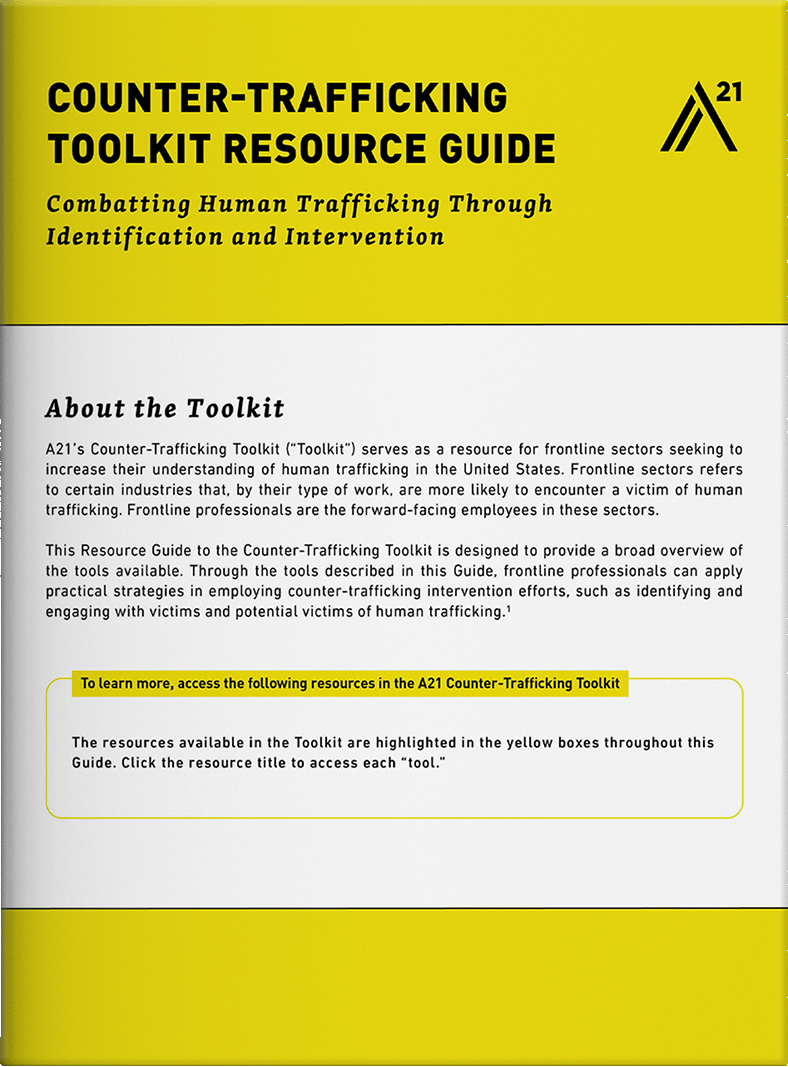
Counter-Trafficking Toolkit Resource Guide
The Resource Guide provides a broad overview of the tools available to equip yourself and train your team.
Access the Resource Guide for a description of each tool available, or select training tools from the categories below.
.
.
.
.
Counter-Trafficking Toolkit Resource Guide
The Resource Guide provides a broad overview of the tools available to equip yourself and train your team.
Access the Resource Guide for a description of each tool available, or select training tools from the categories below.
Confirmation Content
Counter-Trafficking Toolkit

Human Trafficking and Exploitation
Information about the law, the types of human trafficking in the United States, and online child sexual exploitation
.
.

Recognizing a
Human Trafficking Situation
Recognizing human trafficking, victim identification and recovery, and indicators of trafficking in your industry
.
.

Engaging with a Potential Victim of Trafficking
The victim-centered approach and resources to share with potential victims of trafficking
.
.

Counter-Trafficking Strategies and Awareness Campaigns
Developing a counter-trafficking strategy and Can You See Me? awareness materials to distribute in your community
.
.

Law Enforcement Extension "Tools"
The victim-centered appraoch, indicators of trafficking in law enforcement investigations, and the Victim Assistance Survey
.
.

Training Videos
.
.
Human Trafficking and Exploitation
Information about the law, the types of human trafficking in the United States, and online child sexual exploitation
.
.
Recognizing a
Human Trafficking Situation
Recognizing human trafficking, victim identification and recovery, and indicators of trafficking in your industry
.
.
Engaging with a Potential Victim of Trafficking
The victim-centered approach and resources to share with potential victims of trafficking
.
.
Counter-Trafficking Strategies and Awareness Campaigns
Developing a counter-trafficking strategy and Can You See Me? awareness materials to distribute in your community
.
.
Law Enforcement Extension "Tools"
The victim-centered appraoch, indicators of trafficking in law enforcement investigations, and the Victim Assistance Survey
.
.
Training Videos
.
.
Confirmation Content
Human Trafficking and Exploitation
Human Trafficking and Exploitation
Human Trafficking in the United States
Explains human trafficking laws in the United States, the types of trafficking most prevalent in the United States, and human trafficking recruitment methods.
.
.
Online Child Sexual Exploitation
These two guides provide information about how to safeguard against online child sexual exploitation, tailored to the reader’s age.
.
.
Confirmation Content
Can You See Me? Scenario Guide
This training manual explains the federal law, recruitment methods, exploitation types, and indicators of human trafficking scenarios.
Click here to view the Can You See Me? films depicted in this Scenario Guide.
.
.
Confirmation Content
Engaging with a Potential Victim of Trafficking
Engaging with a Potential Victim of Trafficking
Victim-Centered Approach
Explains the use of the victim-centered approach when engaging with potential victims of trafficking, which involves taking a trauma-informed perspective to support the individual and prioritizing their needs and concerns.
.
.
Confirmation Content
Victim-Centered Approach Videos
These industry-specific training videos explain how to use a victim-centered approach when interacting with a potential victim of trafficking.
Confirmation Content
Resources for Potential Victims of Trafficking
.
Resources for potential victims of trafficking
Preventative Labor Exploitation Passport
This resource can be handed out to potential victims of labor exploitation and at-risk communities.
.
.
Confirmation Content
Entertainment Industry Safeguarding Resource
This resource can be handed out to potential victims of exploitation within the entertainment industry.
Confirmation Content
Counter-Trafficking Strategies and Awareness Campaigns
.
Counter-Trafficking Strategies and Awareness Campaigns
Developing a Counter Trafficking Strategy
Provides an overview of the best practices in adopting a holistic counter-trafficking strategy in frontline sector organizations.
.
.
Can You See Me? Indicator Posters
Summarizes the key signs and exploitation types for each type of trafficking illustrated in the campaign scenarios; these posters can be placed in strategic locations.
Download Exploitation Type Resources ▸
Download Story-Telling Resources ▸
.
Confirmation Content
Resource Overview of the Can You See Me? Awareness Campaign
Provides an overview of the purpose and the methodology of A21’s Can You See Me? awareness campaign. The resource also provides guidance on how to implement the campaign to spread awareness and support intervention efforts.
.
.
Confirmation Content
Recognizing a Human Trafficking Situation
.
Recognizing a Human Trafficking Situation
Recognizing Human Trafficking
Explores the different types of human trafficking in the United States, how to recognize a possible trafficking situation, and guidance on engaging with a potential victim.
Confirmation Content
Identification vs. Recovery
Provides insight into the barriers of victim identification, and explains the point of identification and recovery as two distinct parts of a survivor’s journey out of a trafficking situation and the nuances of each stage.
Industry Specific Indicators
Specific indicators that you may see in your daily work to help recognize signs of human trafficking.
Download Healthcare Indicators ▸
Download Hospitality Indicators ▸
Confirmation Content
Law Enforcement Extension "Tools"
These resources are only available to law enforcement.If you are in law enforcement, please check your inbox for the access password.
Law Enforcement Extension "Tools"
These resources are only available to law enforcement. If you are in law enforcement, please check your inbox for the access password.
Law Enforcement Indicators of Trafficking
Specific indicators of sex and labor trafficking that you may see in your daily work.
.
Victim Assistance Survey
This printable survey can guide your assessment of the needs of a potential victim of trafficking.
.
Confirmation Content
Victim-Centered Investigations
Taking a victim-centered approach to labor trafficking investigations.
.
Victim-Centered Approach Video
This training video provides an overview of the victim-centered and trauma-informed approach.
.
Confirmation Content
Download the Full Toolkit
Confirmation Content
Counter-Trafficking Toolkit

Utilize These Resources to Combat Human Trafficking
Through Identification & Intervention

Through the "tools" provided in this Toolkit, you can equip yourself and train your team on recognizing signs of human trafficking in the United States, apply practical strategies in employing human trafficking intervention efforts, and implement processes for identifying and engaging with victims of human trafficking.
Counter-Trafficking Toolkit
Utilize These Resources to Combat Human Trafficking Through Identification & Intervention
Through the "tools" provided in this Toolkit, you can equip yourself and train your team on recognizing signs of human trafficking in the United States, apply practical strategies in employing human trafficking intervention efforts, and implement processes for identifying and engaging with victims of human trafficking.
.
.
Resource Guide
For guidance on how to use the Toolkit and an introduction to human trafficking, access the Resource Guide below.
.
Learn more about Human Trafficking and Exploitation
.
Learn more about Human Trafficking and Exploitation
.
Human Trafficking in the United States
Explains human trafficking laws in the US, as well as the types of trafficking most prevalent in the US.
.
Can You See Me? Scenario Guide
Explores how to recognize and identify a potential victim, illustrating red flag indicators and guidance on engaging with a potential victim.
.
Adult Guide: Online Child Sexual Exploitation
Provides information about online child sexual exploitation and how to safeguard against online exploitation.
.
Youth Guide: Online Child Sexual Exploitation
Provides age appropriate information about sextortion and how to safeguard against online exploitation.
.
Recognizing Human Trafficking in the Rail Sector
.
Recognizing Human Trafficking in the Rail Sector
.
Amtrak x A21 Rail Indicators
Learn specific indicators to help you recognize human trafficking.
.
Recognizing Human Trafficking
Explores how to recognize and identify a potential victim, illustrating indicators and guidance on engaging with a potential victim.
.
Identification vs. Recovery
Explains identification and recovery as two distinct parts of a survivor’s journey out of a trafficking situation and the nuances of each stage.
.
Engaging with a Potential Victim of Trafficking and Applying Counter-Trafficking Strategies
.
Engaging with a Potential Victim of Trafficking and Applying Counter-Trafficking Strategies
.
Victim-Centered Approach
Explains the importance of and how to implement a victim-centered approach when engaging with potential victims of trafficking.
.
Preventative Labor Exploitation Passport
This resource can be handed out to potential victims of labor exploitation and at-risk communities.
.
Developing a Counter Trafficking Strategy
Provides an overview of the best practices in adopting a holistic counter-trafficking strategy in frontline sector organizations.
.
Can You See Me? Indicator Posters
Summarizes the key signs and exploitation types for each type of trafficking illustrated in the campaign scenarios; these posters can be placed in strategic locations.
Download Story-Telling Type Resource ▸
.
.
Law Enforcement Extension "Tools"
.
Law Enforcement Extension "Tools"
.
Law Enforcement Indicators Sex Trafficking
Specific indicators of sex trafficking that you may see in your daily work.
.
Law Enforcement Indicators Labor Trafficking
Specific indicators of labor trafficking that you may see in your daily work.
.
Victim-Centered Sex Trafficking Investigations
Taking a victim-centered approach to sex trafficking investigations.
.
Victim-Centered Labor Trafficking Investigations
Taking a victim-centered approach to labor trafficking investigations.
.
Victim Assistance Survey
This printable survey can guide your assessment of the needs of a potential victim of trafficking.
.
.
.
Training Videos
.
Training Videos
.
.
Victim-Centered Approach
The basis of some points are from source: Bates, Rebecca Ann (2020). Using Trauma-Informed and Victim-Centered Approaches To Provide Assistance to Survivors of Human Trafficking Doctoral Dissertation, Valdosta State University and US Dept. of Health and Human Services (2014). Trauma-Informed Care in Behavioural Health Services. Rockville (MD). (Treatment Improvement Protocol (TIP) Series, No. 57.) Chapter 3, Understanding the Impact of Trauma, table 1.3-1.
Learn how to implement a trauma-informed and victim-centered approach when engaging with potential victims of trafficking.
.
.
Confirmation Content